Freight broker software used to be evaluated on a fairly simple question: can it help move loads efficiently? That benchmark no longer reflects the reality brokers are operating in today. As market conditions tighten and operational complexity increases, software decisions are playing a much larger role in profitability, risk management, and customer expectations. What brokers need from their technology has fundamentally changed.
Today’s brokers need more from their TMS; they need security and a connected network that supports scalable, profitable growth.
The questions brokers are asking have evolved. Instead of focusing on execution alone, teams are evaluating whether their systems can:
- maintain margin consistency
- reduce exposure to fraud
- scale operations without increasing headcount
According to the Transportation Intermediaries Association (TIA), unlawful brokerage remains one of the most frequently reported types of fraud in the freight industry. Technology is no longer a back-office consideration. It has become a core lever for managing risk and sustaining growth.
What is freight broker software?
Freight broker software refers to transportation management systems (TMS) designed specifically for brokers and 3PLs. These platforms centralize and automate the workflows required to move freight from tender to settlement.
Typical capabilities include:
- load management
- carrier sourcing & communication
- dispatch & execution
- documentation
- invoicing & financial workflows
- shipment tracking
- reporting & performance analytics
Over time, expectations have expanded. These systems are now evaluated based on how effectively they support decision-making, not just transaction execution.

The biggest challenges freight brokers face in 2026
Understanding the current operating environment helps clarify why software requirements have expanded.
Margin pressure
Freight markets remain volatile, and rate fluctuations can quickly erode profitability. Even small inefficiencies—manual processes, poor pricing decisions, or delays—have a measurable impact. As margins tighten, brokers are under increasing pressure to do more with existing resources while maintaining service levels and controlling costs.
Fraud and carrier risk
Incidents involving double brokering and identity theft continue to increase. Manual vetting processes are often too slow to keep pace, leaving brokers exposed. Recent regulatory developments, including the SCOTUS decision in Montgomery v. Caribe II, have also placed greater attention on how carrier selection decisions are made, documented, and defended.
Visibility expectations
Shippers expect accurate, real-time updates. Manual check calls are difficult to scale and often lead to inconsistent service. Without reliable visibility, teams spend more time chasing updates and less time focused on higher-value activities that drive customer satisfaction and growth.
Operational complexity
As brokerages grow, they manage more loads, more partners, and more data. Without the right systems, scaling often means adding people rather than improving efficiency. Over time, disconnected workflows and manual processes can make it difficult to maintain service levels while supporting continued growth.
Capacity access
Securing reliable carriers quickly requires speed, data accuracy, and trust—factors that are difficult to manage manually. Delays in sourcing qualified capacity can impact service levels, customer satisfaction, and profitability, particularly during periods of market disruption or tight capacity.
Connected platforms are redefining freight broker software
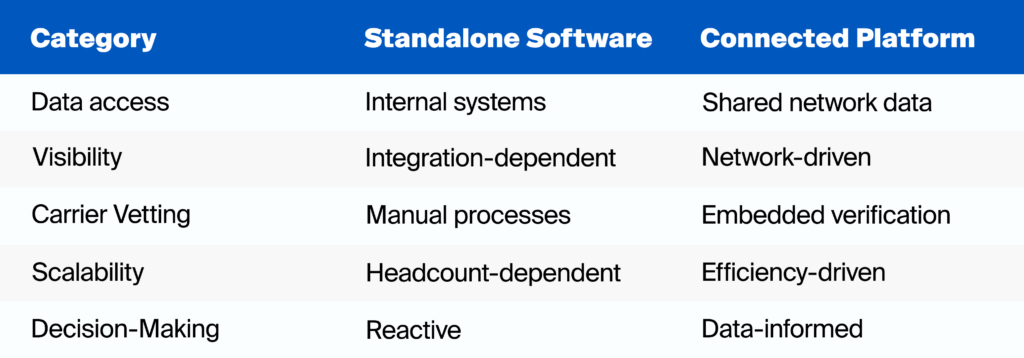
Many brokerages still rely on separate tools to manage visibility, carrier onboarding, compliance, and freight operations. While this approach can work, it often creates fragmented data, duplicated work, and slower decision-making as shipment volumes and customer expectations increase.
At the same time, brokers are being asked to do more than simply move freight. They need to secure trusted carrier capacity, monitor shipments in real time, reduce fraud exposure, and respond quickly when disruptions occur. Meeting those expectations becomes increasingly difficult when critical information is spread across multiple systems.
As a result, many organizations are looking toward connected platforms that bring together operational workflows, visibility, compliance, and network intelligence. Through the Descartes Global Logistics Network™ (GLN), brokers can access a broader ecosystem of carrier, shipment, and operational data that supports faster capacity sourcing, stronger carrier verification, more reliable visibility, and better-informed decision-making. Combined with Descartes MyCarrierPortal™, Descartes MacroPoint™ FraudGuard, and Descartes MarcroPoint OpsForce AI, this connected approach helps brokers operate with greater confidence, efficiency, and control in an increasingly complex freight environment.
Where Descartes Aljex fits
Descartes Aljex aligns with this shift toward connected platforms. Our cloud TMS integrates with freight tech partners and connects brokers to thousands of companies through EDI and API connectivity. Its capabilities expand further when combined with other Descartes solutions:
Descartes MacroPoint
Purpose built to provide end-to-end visibility through every stage of the transportation journey, and proven to deliver reliable connectivity, reduce costs, and enable real-time collaboration.
Revolutionized Our Freight Visibility with Real-Time Tracking.
Jorge T. – Visibility Tools Senior Team Lead
Descartes MyCarrierPortal
Supports carrier onboarding, identity verification, compliance monitoring, and fraud prevention driving multi-faceted security and transparency within your carrier network. Businesses using integrated TMS and real-time visibility solutions can reduce manual check calls and improve operational efficiency.
MyCarrierPortal Is a Game-Changer for Real-Time Carrier Vetting.
William R. – Freight Broker / Load Planning Manager
Freight broker software vs. connected logistics platforms
Essential freight broker software features today
Workflow automation
Automation reduces manual effort across load entry, dispatch, and invoicing, allowing teams to handle more volume without proportionate headcount growth.
We’re faster and more accurate than we’ve ever been and we wouldn’t be where we are today without how efficiently our systems work—and how our people work within them.
Jason McArthur, President, Lone Cypress Logistics
Real-time visibility
Consistent tracking improves service quality and enables faster response to exceptions, while reducing time spent tracking by 60% on average.
Descartes MacroPoint has been a massive time saver for us. Prior to implementing the solution, we spent in the neighborhood of four to five hours per day tracking and receiving updates on loads. Now that most of the information is pushed from Descartes MacroPoint, we’re down to the two-hour mark for tracking loads—and we can always stay steps ahead of any shipment issue.”
Keegan McCready, Sr. Project Manager, Steelcase Inc.
Carrier onboarding and compliance
Structured onboarding and verification workflows reduce fraud exposure and ensure regulatory compliance.
Since implementing Descartes MyCarrierPortal into our carrier on-boarding process, we have been able to efficiently increase the size of our carrier network. This service has dramatically improved our overall risk management. We can access all of the carrier’s pertinent information in one streamlined database that is easy to navigate.
Steve Lyons, President, Vine Line Logistics
Pricing and lane intelligence
Access to accurate data supports better pricing decisions and stronger margin control, so you can save time, drive efficiencies, and make more profitable decisions.
With the efficiencies we have realized with the combined Descartes Aljex and Descartes MacroPoint solution, we’ve been able to boost profitability by scaling our transportation logistics practice without increasing headcount. And most importantly, our customers are happy.
Michael Feig, COO, Capital Logistics
Integrations and connectivity
Seamless integration with load boards, accounting platforms, and external systems reduces operational friction.
Descartes Aljex is a great system with comprehensive capabilities. It has definitely helped us manage our growth, especially because of its ease of use.
Jordan Williams, Director of Operations, Freight Tec
Reporting and analytics
Clear performance insights from high-value data help brokers identify inefficiencies and improve decision-making, ensuring your business thrives.
With Descartes’ platform, we can rip through load building, add new carriers quickly, and provide updates and alerts our customers require. We’re faster and more accurate than we’ve ever been and we wouldn’t be where we are today without how efficiently our systems work—and how our people work within them.
Jason McArthur, President, Lone Cypress Logistics
Choosing the right freight broker software
With so many platforms competing for attention, selecting the right freight broker software requires looking beyond feature lists and product demonstrations. The most effective solutions help brokers improve operational efficiency, strengthen carrier relationships, reduce risk, and make more informed business decisions.
Over time, the impact of a platform extends beyond individual features. It influences how efficiently teams work, how quickly decisions are made, and how effectively the business can scale.
The demands placed on freight brokers continue to evolve. Rising customer expectations, increasing fraud concerns, and growing operational complexity are driving demand for solutions that deliver greater visibility, automation, and connectivity. As brokers look for new ways to improve efficiency and protect profitability, technology is becoming a more important source of competitive advantage across every stage of the freight lifecycle.more important source of competitive advantage across every stage of the freight lifecycle.
Final thoughts
Freight broker software plays a central role in how brokers manage profitability, risk, and growth.
The platforms delivering the most value are those that:
- reduce operational friction
- improve data quality
- support faster, more informed decisions
As the industry evolves, operating within a connected ecosystem; supported by solutions like Descartes Aljex, Descartes MacroPoint, Descartes MyCarrierPortal, and the Descartes Global Logistics Network, will increasingly define competitive advantage.
Learn how connecting your operations to the Descartes Global Logistics Network can unlock better visibility, stronger compliance, and more efficient growth.