Key Takeaways
- Understanding Freight Broker Software or TMS: Freight broker software, also known as Transportation Management Systems (TMS), optimizes logistics operations by seamlessly matching shippers with carriers, efficiently managing load assignments, and providing real-time tracking for shipments across the supply chain.
- Key Benefits for Your Business: A robust TMS not only enhances operational efficiency and reduces costs, but also elevates customer satisfaction by improving service reliability and transparency, helping businesses stay competitive in an ever-evolving logistics landscape.
- Who Can Benefit from TMS?: The right TMS offers scalable and adaptable solutions that cater to a wide range of logistics professionals, from small freight brokerages to large enterprises, improving visibility, optimizing routing, and enabling more informed decision-making across the board.
A modern freight broker doesn’t just need software, it needs reliable, cloud-based operational infrastructure that replaces spreadsheets, phone tag, and siloed tools or data. In 2026, transportation management systems (TMS) have maintained their role as the freight broker software that is mission-critical to success. It is the place brokers centralize rates, carrier onboarding, capacity sourcing, visibility, billing, and the analytics that drive improved profitability and performance. A strong TMS is purpose-built to enable the ability to scale enterprise ready operations as well as empower growth for small and mid-size brokerages as they mature.
Why this matters
Market volatility, tighter capacity, and higher customer expectations mean brokers must act faster, and with better data. A modern TMS reduces exceptions, shortens order-to-cash cycles, and shifts work from manual coordination to automated, auditable processes. For brokers close to enterprise scale, that translates to preserving margin while increasing throughput without linear increases in headcount. Many customers using an effective TMS cite measurable benefits, including reported savings of 5%–20% in freight spend through improved planning and carrier selection, 2-3x increase in productivity related to load coverage per employee, and an on-time delivery percentage greater than 98%.
What a broker-grade TMS must deliver
A broker-grade TMS is more than a checklist of features it’s a unified platform that turns operational data into repeatable success. For brokers that prioritize efficiency and productivity, the essentials are:
Here are common challenges freight organizations may face and the coinciding feature that can help:
- Broker-first workflows. Simplified order entry, consolidated rate management, automated load planning / tendering, lane pricing, and secure agent models that reflect brokerage industry standards. Your TMS should emphasize a broker-centric design with role-based customizations to fit the needs of your staff. This increases user adoption and amplifies winning habits across your team.
- Deep ecosystem integrations.
- Real-time visibility: Native visibility integrations enable location pings, ETA updates and geofence-driven status automation so check calls and exceptions are reduced.
- Carrier onboarding & compliance: Automated carrier packet flows and insurance monitoring that keep carrier data fresh and reduce manual entry.
- Carrier vetting and fraud prevention: The rise in identity theft, double brokering, and organized cargo theft makes it critical to verify carrier legitimacy in real time. It is key for brokers to detect red flags early and prevent bad actors from infiltrating their network before a load is ever assigned.
- Rate & capacity feeds: Direct connections to rating intelligence providers and internal capacity / smart search tools that surface top carriers and historical lane performance.
- Financial & EDI integrations: Electronic payments, factoring partners and electronic data interchange (EDI) (204/210/214 and other common transaction sets) to speed up billing and reconciliation events automatically.
- Actionable analytics & reporting. A TMS must surface key performance indicators (KPIs) such as load-to-user ratios, lane profitability, and carrier performance so leaders can fine-tune pricing and staffing instead of guessing. Internal guidance emphasizes these operational KPIs as the core of measuring TMS success.
Top 11 Best Rated TMS Broker Platforms by G2 Score *
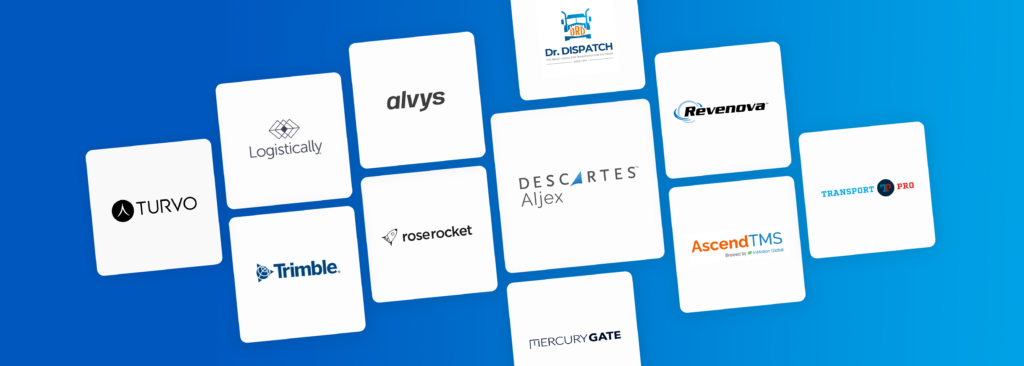
- Descartes Aljex
- Rating: 4.6 / 5
- Reviews: 412
- Trimble TMS
- 3.7/5
- 25 reviews
- Turvo
- 4.4/5 stars
- 20 reviews
- Rose Rocket
- 4.8/5 stars
- 15 reviews
- Revenova TMS
- 4.3/5 stars
- 42 reviews
- MercuryGate TMS
- 4.0/5 stars
- 16 reviews
- Transport Pro
- 4.7/5 stars
- 97 reviews
- Logistically TMS
- 4.8/5 stars
- 10 reviews
- Dr. Dispatch
- 4.4/5 stars
- 11 reviews
- Alvys
- 4.7/5 stars
- 17 reviews
- Ascend TMS
- 4.4/5 stars
- 8 reviews
*Source: Best TMS by G2
Getting live and realizing value
Implementation should be a staged program geared to early wins:
- Prioritize integrations. Start with visibility, carrier onboarding and rate feed integrations that eliminate the most manual work and produce measurable improvements quickly.
- Train for outcomes. Adopt a staged training plan, record sessions for reinforcement, and designate internal “super-users” to accelerate adoption.
- Measure immediate KPIs. Early indicators of success include faster load building, fewer manual check-calls, reduced billing exceptions and improved load-to-user productivity.
When planned and executed, an onboarding program converts these early operational wins into sustainable efficiency and recurring margin gains.
Common buyer questions
How quickly will we see value?
Expect early wins (faster quoting, fewer exceptions) in weeks; billing/analytics gains as integrations mature across months. A proven TMS implementation cadence is designed for quick, staged value.
Will carriers need to adopt more complicated processes?
By automating onboarding, monitoring and carrier packet flows, the ask of your carriers should be much simpler, helping establish your business as a broker of choice for those carriers. Integrations and continuous monitoring reduce carrier friction and keep carrier records current.
What makes Descartes Aljex different?
Broker-built UX, cloud scalability, rich integrations (visibility, rate sources, EDI/financials) and a proven onboarding program make it a pragmatic choice for brokerages scaling toward enterprise.
Quick self-check: Is it time to consider a TMS?
If any of these are true, it’s worth a deeper look: repeated billing exceptions, frequent manual check-calls, multiple offices/agents, inconsistent carrier onboarding, or inability to scale without hiring. These are classic triggers where a TMS shifts cost and risk profiles quickly.
Are You Evaluating a TMS for Your Brokerage?
Treat your TMS as infrastructure and a strategic platform that protects margin and enables growth. Descartes Aljex combines broker-first workflows, deep ecosystem integrations and an onboarding approach designed to convert wins into lasting operational advantage.